

The guest chooses dates, confirms their stay, and says: "I'll make the transfer this evening." The room is blocked in the calendar, the dates disappear from availability, and the booking seems almost certain.
Evening has passed. Then another day. The payment is still not here.
And then the problem arises: do I still keep the appointment for this guest, or do I cancel it for another person?
The absence of online payments at a lodging facility often doesn't seem like a big deal. After all, you can send your bank account number, wait for the transfer, and manually check the payment. The problem begins when there are more such bookings, and each of them remains "in limbo" for a while: it exists, but hasn't yet been confirmed by payment.
A reservation without payment is an uncertain reservation
For a property owner, a booking means a specific room, date, and revenue. For a guest, it might still be one of several options under consideration.
If the process ends with a conversation, email or form without payment, the guest can postpone the bank transfer, forget, or choose another property. During this time, the date remains blocked, even though there is no certainty that the stay will actually take place.
This is particularly problematic during the season, at weekends and with last-minute room availability.
What does the lack of online payment cost?
The lack of online payments is not just a delayed transfer. It's also extra work and greater uncertainty.
You need to check the account, send reminders, reply to messages, and decide how long to wait for payment. With one booking, it's a trifle. With several a week, it becomes a constant duty.
On top of that, there's the mess with the statuses: a guest has confirmed but not paid; they claim to have made a bank transfer, but the funds haven't appeared yet; a payment has arrived, but it needs to be manually marked.
Without online payments, it's also harder to limit the risk of no-shows. A guest who hasn't paid a deposit or paid for the booking may treat it less obligingly.
Online payment streamlines the process
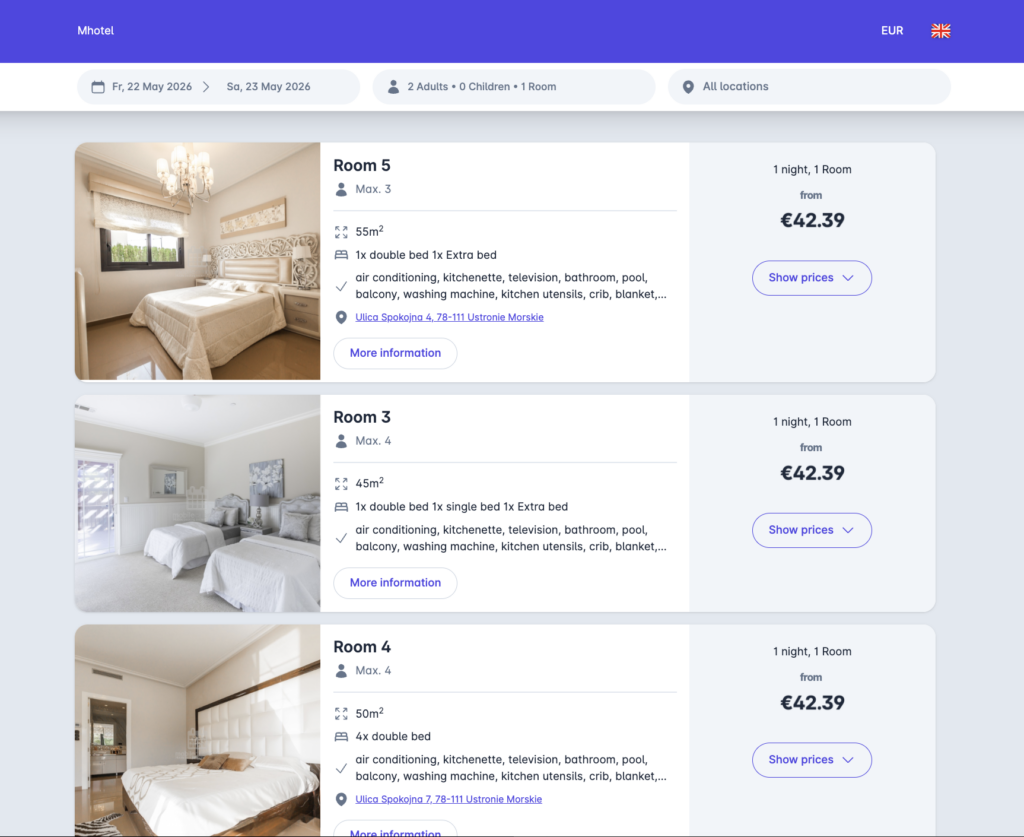
An online booking system with payments allows the guest to complete the entire process immediately: choosing a date, room, offer, filling in their details, and making a payment.
For the establishment, this means less manual supervision and fewer uncertain bookings. Payment becomes part of the booking, not a separate task to check later.
Not every property needs to take the full amount immediately. Often, an online booking deposit is sufficient, which confirms the guest's decision and secures the date.
How does mobile-calendar help?
In mobile-calendar online payments are part of online booking system. The property can accept bookings directly through its own website, and guests can proceed independently from selecting a date to payment.
The system supports deposits or full payments and the use of payment gateways such as Stripe, PayPal, PayU or Przelewy24. This allows payments to be linked to specific bookings, dates and offers.
Additionally, you can take advantage of various pricing plans, such as standard, non-refundable, or last-minute, allowing the payment method to be tailored to a specific offer.
Summary
The lack of online payments doesn't just cost time waiting for transfers. It also means manual reminders, uncertain bookings, blocked slots, and a greater risk of no-shows.
A well-configured online booking system helps to organise this process. Guests book conveniently, the property receives a clear signal, and the owner or reception don't have to manually chase every payment.
Because payment should not be a separate issue after booking.
It should be a natural part of the booking.