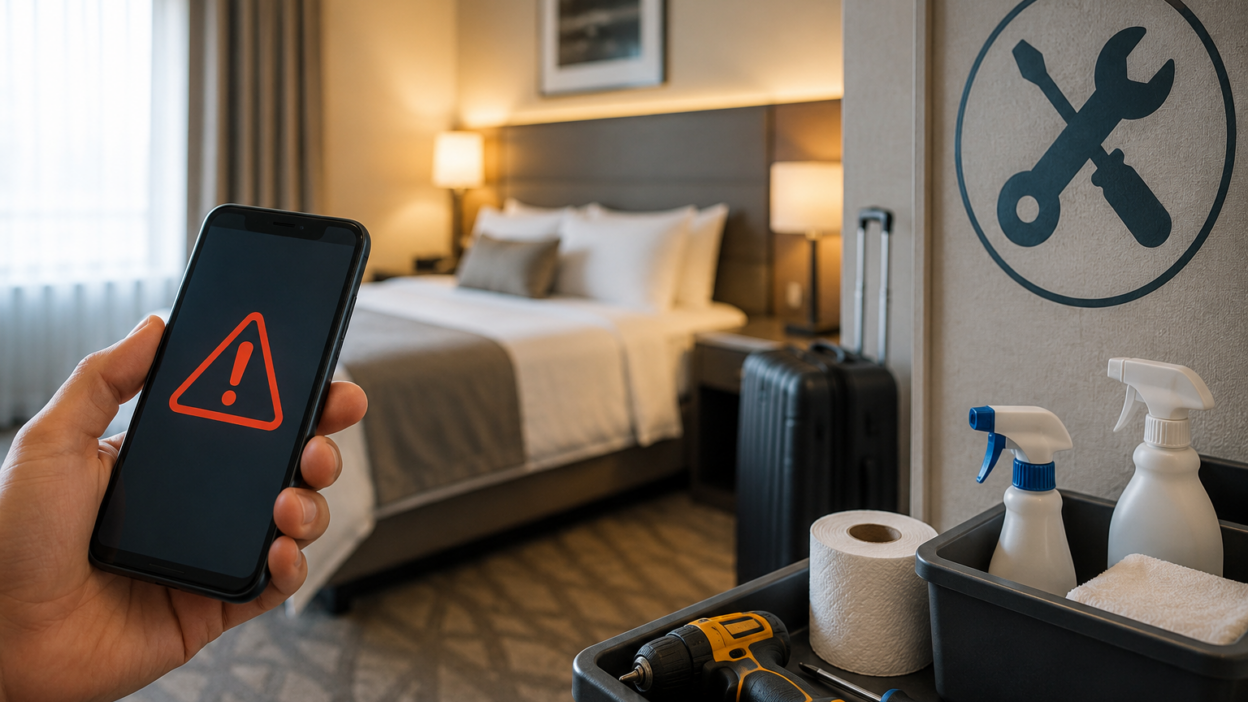
There are three hours left until the guest arrives. While cleaning, it turns out that the bedside lamp in the room is not working. A moment later, it comes to light that the air conditioning is not responding either.
And that is where the questions begin.
Can the room still be prepared? Do we need to block it? Who will take care of the fault? Does reception know about the issue? Do we need to contact the guest?
Same fault in the hotel room it does not have to cause chaos. The problem begins when information about it lacks a status, a person responsible and a defined next step.
First determine: does the fault prevent the stay?
Not every fault means that the room cannot be sold or handed over to a guest.
A burnt-out bulb in one of two wall lamps is a different situation to a broken lock, a lack of heating in winter or a plumbing failure.
Therefore, the first question should not be:
Can anyone fix this?
It is better to start with:
"In its current state, can the room safely and comfortably accommodate a guest?"
A simple division can be made:
| Fault status | Example | What next? |
|---|---|---|
| Minor | damaged decorative light | fix before arrival if possible |
| Requires attention | broken television | assess the impact on the stay and make a decision |
| Full | problem with the lock or heating | repairs before check-in |
| Blocking | no water, major plumbing failure | the room should not take another guest |
Such a categorisation makes it easier to make a decision without treating every fault as a crisis situation.
Five pieces of information you need to write down straight away
Message:
There's something wrong with the shower in number five
That's not enough.
If the problem is to be resolved efficiently, five things must be noted down:
1. Where did the fault occur?
Room, apartment or chalet number.
2. What exactly is not working?
Instead of "bathroom problem":
Water appears under the washbasin when the tap is turned on.
The more detailed the description, the fewer additional calls.
3. Does it affect the possibility of hosting a guest?
This is the most important piece of information for reception and the person managing availability.
4. Who is dealing with the issue?
Owner, conservator, technician or external service.
5. By when is the problem to be checked?
Especially if the next guest arrives on the same day.
A well-written piece of information might look like this:
Apartment 4 – the siphon under the washbasin is leaking. Next guest arriving at 16:00. Issue reported at 11:20, maintenance is supposed to arrive by 13:30. Until the repair is confirmed, the room is not marked as ready.
Anyone who sees such a record immediately knows what the situation is.
Fault detected during cleaning – what should happen next?
Cleaning staff are very often the first to notice a problem.
It's natural. When preparing the room, you might notice things that the guest didn't report beforehand:
- broken light
- damaged socket
- a loose door handle,
- leak
- air conditioning problem
- damaged equipment
- missing element
- problem with the lock
Therefore, the process of reporting a fault should be very simple.
A good scheme looks like this:
Issue detection → fault logging → assessment of impact on stay → assignee allocation → repair → confirmation → change of room status
The worst option is to provide information solely by telephone:
I told the landlord this morning.
A few hours later, it might no longer be clear whether the problem has been resolved.
Do not mark the room as complete until the issue has been resolved
This is particularly important for faults detected just before the next stay.
A room can be:
- tided up
- to have fresh bed linen,
- prepared towels
and still not be ready for the guest.
If an outstanding fault is affecting your stay, the room status should reflect this.
For example:
To be tidied up → In progress → Needs attention → Done
Thanks to this, the reception desk doesn't need to ask the staff:
"Have they fixed that tap yet?"
A visible status should give a clear answer.
When is it a good idea to temporarily block a room?
If the defect prevents normal use of the room and it is not known whether it will be fixed before the next stay, its availability must be managed accordingly.
This applies in particular to issues such as:
- faulty lock,
- no water,
- a lack of heating at a time when it is needed,
- a major bathroom breakdown,
- security threat
- damage that prevents the basic equipment from being used.
In such a situation, it is important to ensure availability quickly, particularly if the property sells accommodation through both its own website and booking platforms.
mobile-calendar features a central calendar and a Channel Manager for managing availability across multiple channels. The system documentation also covers the option to block rooms.
However, it is not worth automatically closing a room off for every minor fault. You must first assess its actual impact on guests’ stay.
What should you do if there isn't much time left before your arrival?
The most important thing is to set a specific deadline for the decision.
Let’s suppose:
- The guest arrives at 4.00 pm,
- The fault was detected at 11.30,
- The service engineer is due to arrive at 13:00.
It’s not worth waiting until 3.55 pm.
It can be established that:
At 2.00 pm, we’ll make a final decision on whether the room will be available.
This gives time to react if the repair is delayed.
It is worth answering three questions:
- Has the fault been rectified?
- Has the room been checked again?
- Does reception have confirmation that they can begin check-in?
Only then should the status change to "ready".
And what if the problem cannot be resolved?
If the fault genuinely prevents the stay from starting, you should not pretend that there is no problem.
Further action depends on the specific situation and the facility's capabilities, e.g., the availability of another room.
Operationally, however, the most important thing is that:
- the decision was made sufficiently early,
- the person assisting the guest knew the situation,
- availability has been duly updated,
- Communication with the guest was consistent,
- everyone in the team had access to the same information.
The worst-case scenario is one in which reception only finds out about an unresolved fault when the guest arrives.
How does mobile-calendar help to sort out a situation like this?
A technical fault must be physically repaired by a person. The system PMS It is no substitute for a service centre.
It may, however, help to organise the information relating to the problem.
The central ‘mobile-calendar’ allows you to check current and upcoming bookings and see how much time is left until the next stay. The system brings together bookings from various sources in one place, and Channel Manager synchronises availability with linked sales channels.
When several people are working together, individual access levels can help to clarify the division of responsibilities between the owner, the manager and staff carrying out specific tasks.
Notifications regarding arrivals, departures and changes to bookings are also helpful. They make it easier to assess how much time is left to resolve an issue before the next check-in.
Therefore, the most important benefit is not simply the "handling of the fault by the PMS", but the ability to see the problem in the context of a specific room, reservation, and upcoming arrival.
Standard procedure: fault detected before arrival
Once the problem has been identified
- Make a note of your room or flat number.
- Please describe the fault in detail.
- Check the time of the next arrival.
- Assess whether the problem is preventing you from staying.
- Assign the person responsible.
During repairs
- Arrange a time to check again.
- Don’t mark the room as ‘complete’ too soon.
- Secure availability if necessary.
- Please inform the staff handling the next arrival.
Once the problem has been resolved
- Please confirm that the fault has indeed been rectified.
- Check the room again.
- Update his status.
- Please confirm with reception that you are ready to check in.
- Close the case so that it doesn’t come up again during the next shift.
The most common mistakes
“Someone already knows about it”
Information without an assigned person does not provide certainty that the problem will be resolved.
No time given for the next arrival
The same fault looks completely different if the next stay starts in an hour or the following day.
Marking a room as complete too soon
The cleaning has been completed, but the repairs are still ongoing. However, reception considers the room to be ready.
Information via instant messenger only
The message disappears among dozens of other chats after a few hours.
No final confirmation
"The service was supposed to be" does not mean "the fault has been repaired".
Summary
Faults in accommodation are inevitable. The chaos surrounding them does not have to be.
The most important thing is to quickly determine:
- What happened?
- does the issue affect the stay,
- who is solving it,
- how much time is left until the next arrival,
- when the final decision regarding the room's readiness will be made
A well-organised process ensures that a minor glitch remains just that, rather than turning into a problem at check-in.
And if the problem really does make it impossible to welcome a guest, the team finds out about it in good time — not when the guest is already at the door.
FAQ
What to do when a fault is detected just before a guest arrives?
First, you should assess whether it affects the ability to use the room, identify the person responsible for the repair, and set a specific time for a follow-up inspection.
Does every damaged item mean the room has to be locked?
No. Minor issues may not necessarily prevent you from staying. The decision should depend on the nature of the fault, safety considerations and how it affects your use of the room.
Who should report faults?
Anyone who spots them. In practice, this is often the cleaning staff, as they check the condition of the room thoroughly whilst preparing it.
When can the room be marked as ready again?
Only after confirming that the fault has been rectified or does not affect the possibility of commencing the stay, and that the remaining preparations have been completed.
Can PMS help in the event of a room failure?
PMS won’t fix the fault, but it can help you check bookings, upcoming arrivals and availability, and work from a single, up-to-date source of information rather than several separate lists.